


Is it real? Tell me it isn’t real!
The defining moments in film marketing over the last 20 years
Welcome to Spring… and with the ‘Beast from the East’ now a distant memory we are back with another WING Perspective…
It has been a MASSIVE few weeks. We shot 14 gloriously colourful and punchy back-to-back stop motion spots for Chandon in a very busy green screen studio shoot amid snow chaos. Our films for McLaren’s #BeBrave F1 car launch campaign garnered a gargantuan reaction, generating over 10million views in a matter of days. We also headed out to Barcelona to direct a super secretive and truly hilarious project …. all to be revealed later this month.
‘Inclusion’ Riders on the Storm
What’s got us WINGers talking this month? The award season in the world of film… that’s what!
The #MeToo and Time’s Up campaigns were top of the agenda. Cast, crew and execs in their hundreds used their platforms to make a stand and bring about real change. As part of International Women’s Day, our Lead Editor Ania was also part of a panel, hosted by M&C Saatchi, to discuss ‘How Diversity of Thought Can Accelerate the Pace of Change’ which was very much aligned to this powerful and critical movement.
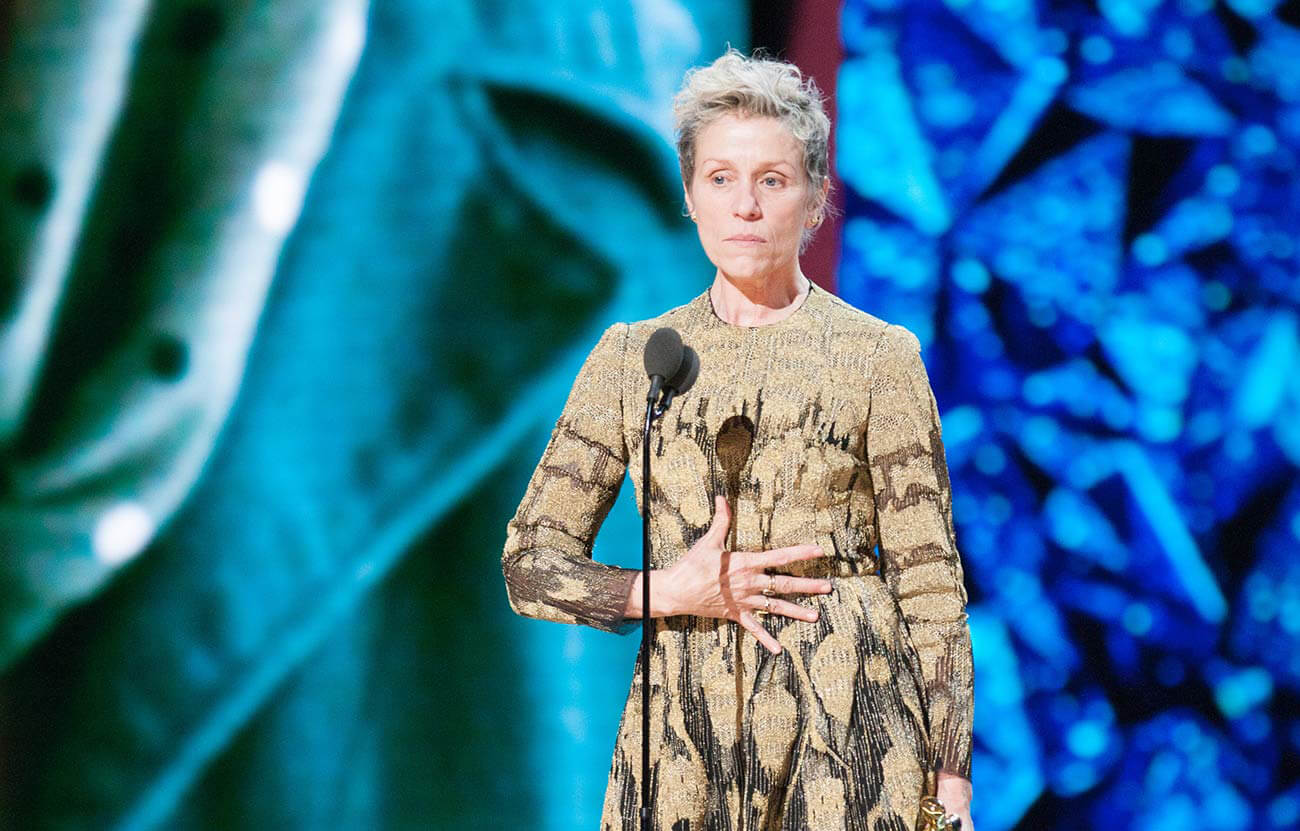
The WINGers were all in agreement that despite Ania being our fave person in the world and being more than awesome as the WING expert, Frances McDormand has reached even higher legendary status than she already had. Not only was her performance in ‘Three Billboards Outside Ebbing, Missouri’ totally out-of-this-WORLD but each of her speeches got better with every win. Culminating in her Oscar and that stunning final statement –
“I have two words to leave you with tonight ladies and gentlemen… ‘Inclusion Rider’”
Two words that will go down in history and may (or may not) very well change the face of film and television – and hopefully many other industries – forever.
With all the talk of the changing landscape, it got us thinking….(dangerous we know) about the defining moments in film marketing over the last 20 years.
We have come across the wildly ambitious, to the exhilaratingly immersive, to the downright scary as hell; however, after much research it seems clear to us that there are two defining moments that have paved the way for everyone else.
Is it real? Tell me it isn’t real!
The internet may have given birth to Viral Marketing, but there was one film that really utilised the Dotcom Bubble and totally changed the game towards the end of the 90s. Yep, it was Batman and Robin starring George Clooney…only kidding. It was… THE BLAIR WITCH PROJECT.
The Blair Witch Project is the ultimate ‘little film that could’. This film was tiny (made for $24,000!) but managed to become one of the most profitable films of all time. It also inspired some of the most profitable films and franchises ever… Paranormal Activity anyone? The key to the film’s success, separate to it being ‘sh*t your pants’ scary, was its ground-breaking and genius marketing campaign. As Den of Geek says:
‘The Blair Witch Project wasn’t the first found-footage film ever made, and neither was it the only such film released in the late 90s. It certainly wasn’t the first piece of American horror to present itself as a true story, either – Edgar Allan Poe was passing tales off as fact in the 19th century. But there was one thing that was new about The Blair Witch Project: its marketing campaign.’
It began with a, now legendary, website – still standing today – blairwitch.com where the history of the mythology, starting with fictional child snatcher named Elly Kedward (The Blair Witch), was posted. There were also references to the three students who went into the woods to document the story and never came back. The footage was ‘found a year later’ and people genuinely believed that the ‘families’ were releasing it for the world to see in the search for answers. This was fresh, new and exhilarating!
‘In October of 1994, three student filmmakers disappeared in the woods near Burkittsville, Maryland, while shooting a documentary. A year later their footage was found…’
The filmmakers shot 19 hours of footage and cut the film down to 90 minutes, so there were plenty of offcuts from the cutting room floor that could be utilised to create more buzz. This, coupled with it being picked up for £1million at Sundance, meant that blairwitch.com could really be used to its fullest potential. The website then started to expand its universe, as fake news stories, more ‘found footage’ and clues as to the student’s whereabouts started to appear. This was combined with perfectly pitched trailers and a great attention to detail – the actors’ IMDb pages (yep no YouTube, Facebook or Instagram but there was IMDb!) stated that the actors were deceased and/or missing. No one had seen anything like this before. It got people talking “Surely it isn’t real?… it isn’t right?”. The myth expanded from there, people just couldn’t get enough of it and modern-day viral film marketing was born
A Horse With No Name
10 years later, another found footage viral marketing game changer was born; Cloverfield. Little White Lies state that ‘Cloverfield ushered in the current era of pre-release publicity and hype marketing’.
This was a JJ Abrams-produced monster movie with (at the time) unknown actors and an incredibly secretive plot. The first people heard of it was at a screening of Transformers (of all films!!). A short scene played where a man is celebrating his leaving party at a penthouse apartment in Manhattan. A huge explosion is suddenly heard from a nearby building. The partygoers go up to the roof to see what’s going on. And then…a dangerous amount of debris comes right for them. They head downstairs into the street and then we see it… a now almost iconic image of The Statue of Liberty’s head being thrown violently towards us, landing in the road, and looking right at camera. The date 1-18-08 appears and a website 1-18-08.com.
No one knew ANYTHING about this film. They wouldn’t even give us a title until much nearer the time of the film. As JJ states: “mystery is more important than knowledge” and boy was this clear in abundance!
By this time many films had tried the Blair Witch style of viral marketing and yet Cloverfield was the only film, in a long time, that managed to really switch things up and create a level of suspense, that even the likes of Hitchcock would have been proud of. There was something different happening here. It was almost as if the creativity of the marketing campaign was as important as the film itself. In the lead up to the film’s release seemingly unrelated films would pop up on YouTube. In one, a fake news story (before fake news was a thing!) tells us how a drilling station in the middle of the Atlantic Ocean has collapsed “in a violent and unexplained circumstance” for no apparent reason. “A dark shape below the surface” is speculated as being an oil spill. But for fans of the upcoming film, this was a stunning teaser of the monster.
Through the film, there are brilliantly placed ‘Easter eggs’ for fans to identify clues as to the expanded universe. What is most impressive about this campaign is the level of detail that went into it. For example in the film, the character Rob Hawkins is leaving the US to go and work in Japan for a drinks company called Slusho. His brother is also wearing a Slusho T-shirt in solidarity. Slusho meanwhile is a fictional Japanese drinks company whose advertising claims that it uses an ‘Irresistible Deep Sea which gives you Accelerated cell growth, increased strength, (and) increased soft muscle tissue growth’. In the Slusho commercial, you even see a consumer being filled with rage. Clues as to how the monster got so big and angry? I think so!
On top of this, Slusho is a subsidiary of Tagruoto, ANOTHER fictional company that drills deep down to the seabed for oil. What’s so impressive is that these fictional companies have full biographies and legitimate looking websites.
It was all just so damn cool. And at the time, it was all new. The marketing grew into more websites, games and requests for UGC where the public were asked to recreate their own monster attack short films until it became viral marketing legend.
Best of the Rest
Viral marketing clearly lends itself beautifully to horror movies, and vice versa, especially ones where the filmmakers want to build mystery-led hype around their release. Sometimes the marketing is so unbelievably inventive that they are better than the films they are promoting.
Take the latest Carrie film for example. The studio decked out a café with full-on stunt level wiring to create a truly terrifying experience, with an actress who could convince people that she ‘actually’ had Carrie-like telekinetic powers.
Devil’s Due is another horror that had a highly inventive marketing campaign. Here they utilised an animatronic demon baby to scare the crap out of unsuspecting members of the public to hilarious results.
Chronicle’s flying human stunt made quite an impression and helped the film earn $100million at the box office, not bad for a film made for $12miilion. District 9 released controversial realistic posters for its increasingly anticipated arrival. This film was made for a $30million budget and managed to to take $200million at the box office. The Simpsons Movie turned a whole bunch of 7/11s into Kwik E Marts, full with slushy machines and Homer’s favourite drool-worthy doughnuts.
The Dark Knight went for more of an Augmented Reality vibe where they got fans to go on reward-based scavenger hunts using clues that the Joker had left on whysoserious.com and ibelieveinharveydent.com.
It’s been 20 years since the release of The Blair Witch and 10 since Cloverfield; clearly, we’re due another game changer…
Finally, our thoughts for our Top three Super Bowl Ads of 2018
Passing itself off as a film trailer for the new Crocodile Dundee film, the Superbowl commercial for Tourism Australia features a whole cast of Austrailia’s brightest stars, the original Dundee himself, Paul Hogan, and as new outback hero: American Danny McBride. It was such a convincing trailer that in their YouTube description, the Australian tourism board had to clarify that ‘Dundee isn’t a Hollywood movie. It’s a giant tourism ad for Australia.’
The most daring and unexpected ad this year went to Budweiser, why? Because it’s a beer commercial… without a beer in sight. Yep, the brewing giant, who usually go for the irreverent, humorous style of Super Bowl advertising, used the platform to promote the wonderful work they do in delivering clean drinking water to communities affected by natural disasters in the US. Using the slogan ‘Whenever You Need Us, We’ll Stand By You’, the company stood out on Super Bowl Sunday in a completely new and powerful way.
This year, there is no doubt for us that Tide took the crown for Best Commercial of Super Bowl 2018. Starring Stranger Things and new Hellboy David Harbour, Tide managed to perfectly parody a whole bunch of Super Bowl ads past and present, perfectly. Each time they cut to a different ‘advert’ Harbour appears abruptly and states ‘Nope, It’s a Tide Ad’. This meant that each and every time another advert appeared, many people’s minds were cast straight back to Tide’s parody. This genuinely funny commercial took everyone by surprise and completely owned the battle of the Super Bowl ads.

